
Annette Mashi
What influenced you to seek a career in architecture?

Annette Mashi
When I was studying computer science at Drexel University in Philadelphia, Pennsylvania, in the '80s, I had no idea what the future of technology would look like. But I knew I was too much of a people person to spend my days alone at a PC.
My next-door neighbour was studying architecture, and he nudged me to give it a try. I was instantly hooked. The field spoke to both sides of my brain, the creative and the analytical. I fell in love with the way spaces connect, how you feel as you move from one room to the next.
I was captivated by the elegance of arches and columns, the precision of calculating structural forces, and the almost magical way hundreds of intricate details come together into something coherent and beautiful.
With degrees in both architecture and computer science, the practical choice was tech. It paid better, and honestly, I wasn't sure how to sell my design ideas. So I followed the money into the computer industry.
Eight years ago, on a group bus trip from the Dead Sea to Jerusalem, I was telling a woman about my architecture degree and my love of design. She shared that she was writing for a company that teaches designers how to market themselves by creating content to attract ideal clients. I’d just left a 17-year IT career at Intel and was looking for my next opportunity. “I love writing,” I told her. “I create magic with words.”
Two years later, when she moved on, she referred me to replace her as an independent content and copywriting partner for the company, opening the door to a passion that feels as intentional as the spaces my clients design.
Since then, I’ve written over 235 blog posts and case studies, 214 emails, and 49 newsletters for architects and interior designers across multiple firms. It’s the perfect combination: my love of writing, my background in architecture, and my instinct for people.
Now I help architects and interior designers get seen, crafting marketing content that attracts the clients they love and lands the projects they dream about.
Which buildings and places shaped your outlook and design philosophy?
Some buildings have an emotional impact, like the Western Wall in Jerusalem. Still in architecture school, I visited Israel and stood before those ancient stones, a retaining wall of the holy temples, and one of the most enduring structures in human history. For me, it carries layers of faith and personal meaning that go far beyond architecture.
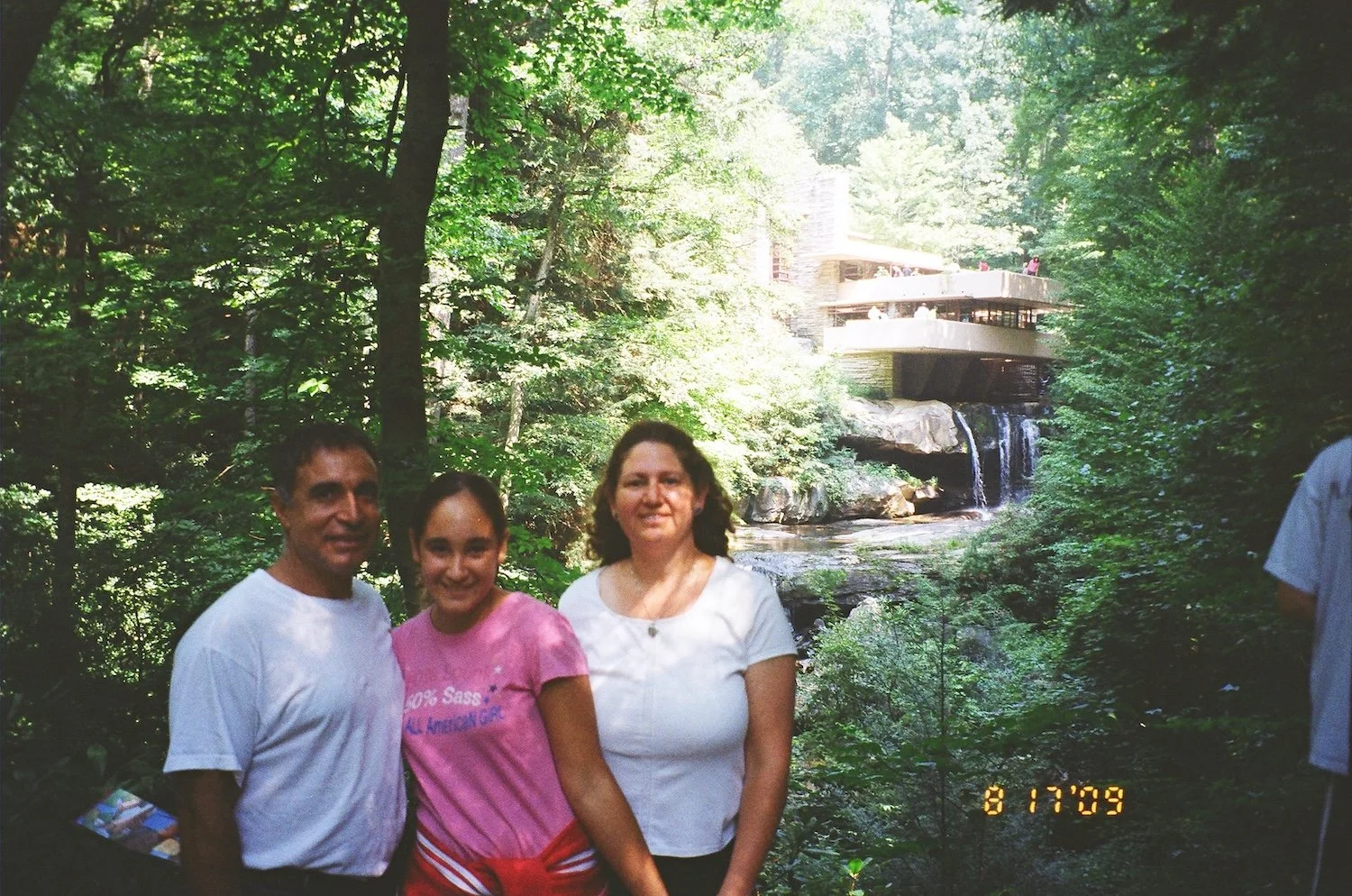
Annette and her family at Fallingwater
My architectural curiosity took me across continents. I fulfilled a 30-year-old dream when I went with my daughter to the Parthenon in Athens. The proportion and permanence are proof that the right geometry can feel timeless. And at St. Peter's Basilica in Rome, I recalled my architecture history professor's lesson about the angels lining the colonnade being larger than life, scaled to appear perfectly proportioned from a distance. There’s so much intentional thought that goes into every design decision.
That same professor introduced me to Wilson Eyre Jr., a Philadelphia architect known for his imaginative Arts and Crafts sensibility. Imagine the delightful coincidence of discovering that a home he had designed had been transformed into my old high school classrooms.
While in architecture school, I designed a theoretical program for a children's centre on a kibbutz in Israel. A kibbutz is a collective settlement built on the principle that each member contributes according to their ability and receives according to their need. Education of the next generation is a cornerstone of kibbutz life, and in the past, children lived together in a dedicated space rather than with their parents.
Designing for a kibbutz meant understanding not just the architecture, but the values it needed to express.
My joy of architecture followed me on road trips, too. Driving cross-country, I made a point of seeing Frank Lloyd Wright's homes in the Chicago suburbs. I was insistent on visiting Fallingwater in Mill Run, Pennsylvania, the iconic house built over a waterfall. Wright designed for you to live within nature, not just look at it. I noticed the low ceilings, scaled to fit the Kaufmann family rather than a standard room height. A reminder that design is always personal.
In St. Louis, the Gateway Arch by Eero Saarinen impressed me so much that I rode the elevator to the top twice, once with my husband, and again years later with my daughters. Some experiences are just worth repeating.
Every place reminded me that architecture moves people in ways they can't always articulate. That's exactly why I love helping architects and designers find the words, so when ideal clients hear a compelling story, magic happens.
What inspired you on your journey?
I was inspired early on by how much a location shapes a building's character. The brick-faced rowhouses of Philadelphia feel entirely different from the old stone homes found in the city's suburbs. I appreciate just how deeply the site influences the materials, form, and feel of a structure.
In 1996, I moved with my husband and 1-year-old daughter to Israel to live near my husband’s family in the Jewish homeland. It was a new beginning, in a new country, with a new language and a different culture. We bought land not too far from my in-laws, and I began designing the home of my dreams.
Even something as elemental as the sun's angle becomes a design decision. In the Israeli desert, wood isn't readily available, so concrete and cement blocks were the natural choice for building my home. Sliding glass doors on the south side invite the winter sun to warm the house naturally, while strategic shading keeps it cool in summer.
Since I've always loved arches, I drew inspiration from my china cabinet and carried that curved elegance into the windows and across the porch. I designed a corner window in the playroom, angled diagonally from the kitchen, with a view of a lemon tree. That room has since become my office as my girls have grown up, but I still treasure the view. The kitchen door opens onto a shaded patio draped in grape vines and jasmine, my favorite spot for morning coffee, where every day feels a little like a picnic.
And like every home built in Israel over the past 25 years or so, mine includes a bomb shelter, now a mandatory part of construction, and one I'm deeply grateful for. In a country where rockets are a real part of life, that room is far more than an architectural requirement. It's a blessing.
That experience of designing my home from the inside out gave me a deep respect for what architects and designers put into every project. It's why telling their stories matters so much to me.
I give visibility to designers who do excellent work but don’t know how to convey their skills through their writing. Today, I specialise in writing for design professionals who’d rather be designing than wrestling with words.
Annette Mashi is the founder of Write Wizards. You can follow her on LinkedIn or visit her Write Wizards website.
This origin story is based on the questions posed in this Sounds Like Design blog article. If you’d like to publish your origin story on our website, please email your text with accompanying portrait and project photos to hello@soundslikedesign.com.au.